Boat Lighting in Palm Beach: Choosing the Right LED Setup for Visibility, Style and Durability
If you are looking into boat lighting in Palm Beach, you already understand that the right lighting setup is not just about aesthetics. It directly affects how safely and confidently you can navigate local waterways, whether you are heading out at dusk, docking after dark, or simply want your vessel to look its best on the water.
Palm Beach boaters face a specific set of conditions. The area sees heavy marine traffic, frequent evening cruises, and a boating culture where both function and appearance carry real weight. Choosing the right LED lighting system means understanding what each type of light is designed to do and which products are built to handle saltwater environments over the long term.
This guide breaks down the main categories of marine lighting, explains what to look for in each, and helps you make an informed decision based on how you actually use your boat.
Why Boat Lighting Matters in Palm Beach Waters
Palm Beach is home to some of Florida’s most active waterways. Between the Intracoastal Waterway, Lake Worth Lagoon, and regular boat traffic near marinas and private docks, proper lighting is both a legal requirement and a practical safety measure.
Federal and state regulations require specific navigation lights to be active from sunset to sunrise and during periods of low visibility. Beyond compliance, well placed lighting helps other boaters see you clearly and helps you read the water around your vessel.
Additionally, Palm Beach’s boating community places value on well maintained, properly outfitted vessels. Lighting plays a role in that overall impression, particularly for those who entertain guests on board or participate in evening events on the water.
Understanding the Types of Marine Lighting
Marine lighting is not a single category. Different lights serve different purposes, and understanding each type will help you build a setup that meets both your practical needs and your visual preferences.
Boat Navigation Lights
Boat navigation lights are required by law for vessels operating between sunset and sunrise or in restricted visibility. These lights communicate your vessel’s position, size, and direction of travel to other boaters.
A standard setup includes a red port light, a green starboard light, a white stern light, and an all round white anchor light. The placement and visibility angles for each light are defined by the U.S. Coast Guard and must be followed to stay compliant on Florida waters.
LED navigation lights have become the standard choice for most boaters because they consume significantly less power than traditional incandescent bulbs, produce a cleaner and brighter output, and last considerably longer. For anyone spending time on Palm Beach waterways after dark, having reliable and properly functioning navigation lights is non negotiable.
Marine Courtesy Lights
Marine courtesy lights serve a different function. They are accent and ambient lights used below deck, along steps, in cockpit areas, and around exterior surfaces. They are not regulatory lights, but they serve real practical purposes.
Courtesy lights help passengers move safely around the vessel in low light conditions. They reduce trip hazards on stairs and deck edges, illuminate storage areas, and create a more comfortable environment for guests. Because they are in constant contact with moisture, spray, and salt air, marine courtesy lights need to be built from corrosion resistant materials with proper IP or waterproof ratings.
LED versions of these lights are now widely available and preferred because they generate minimal heat, draw very little current, and can be found in a range of color temperatures to match different aesthetics on board.
LED Dock Lighting
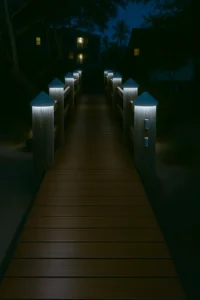
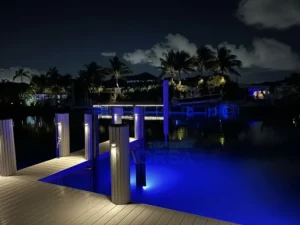
LED dock lighting covers the lights installed along and around your dock structure. This includes underwater dock lights, pilings lights, dock edge lighting, and overhead lighting near dock structures.
Good led dock lighting makes your dock easier to approach at night, reduces the risk of misjudging your slip or bumping into obstacles, and generally makes the dock area safer and more usable after sunset. In Palm Beach, where evening use of private docks and marina slips is common, dock lighting is often treated as a functional necessity rather than an optional upgrade.
Well designed dock lighting also deters marine growth around the dock structure. Certain underwater lights attract baitfish and create an active ecosystem beneath the dock, which is a feature many Palm Beach boaters intentionally incorporate.
Underwater Lighting
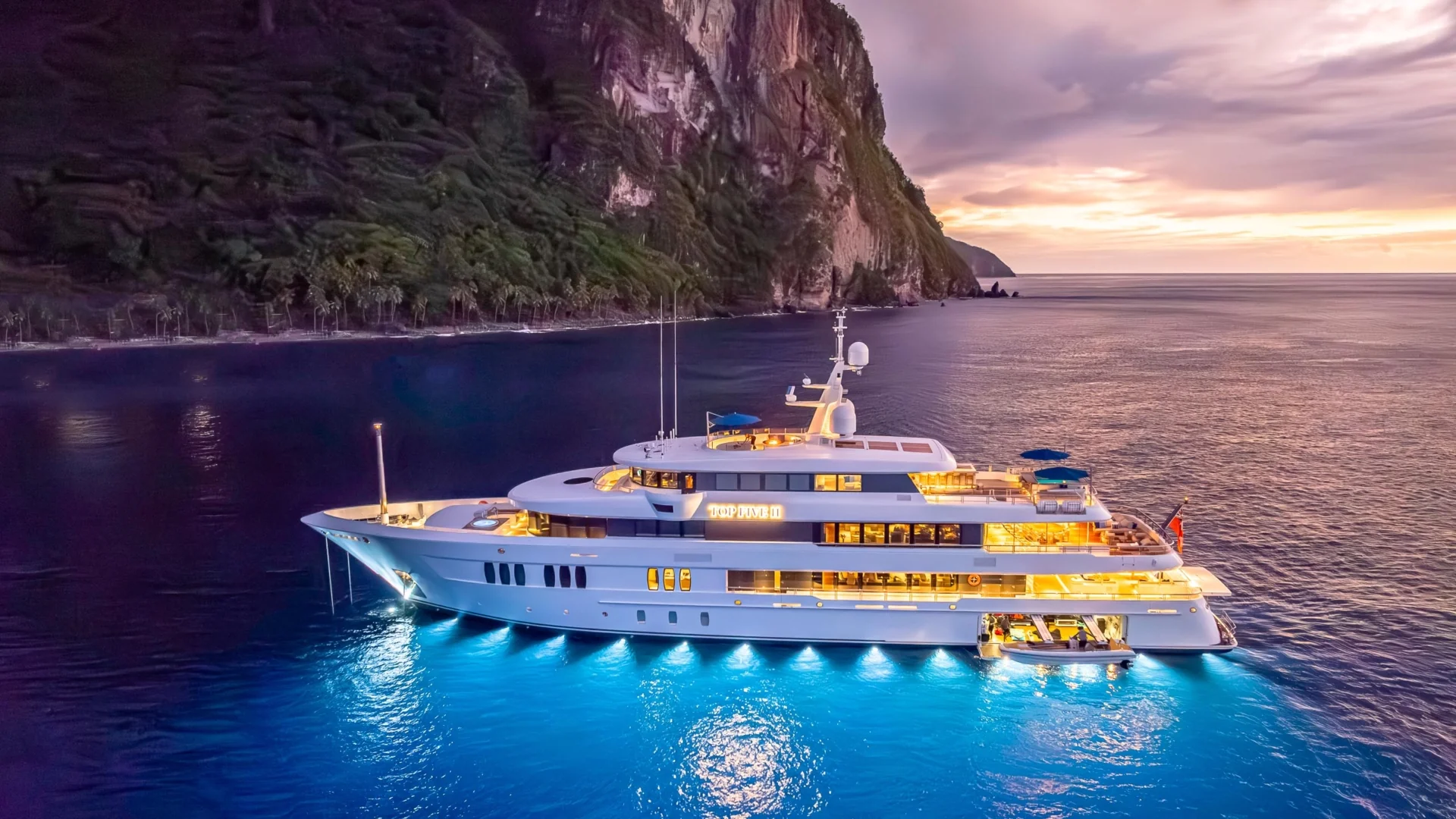
Underwater lights are installed through the hull or mounted to the transom below the waterline. They illuminate the water around and beneath the boat, creating a distinct visual effect and improving visibility of hazards around the hull at night.
These lights require products specifically rated for continuous submersion. The housing, seals, and lens material all need to withstand not just water but also the pressure, temperature variation, and chemical exposure that come with saltwater environments.
Spotlight on the SeaBlaze X3 LED Underwater Light
One product commonly referenced in marine lighting discussions is the SeaBlaze X3 LED Underwater Light. This fixture is designed for through hull and surface mount installation and is built to perform in full submersion conditions.
The SeaBlaze X3 is known for its compact profile, which makes it suitable for a range of hull types without requiring significant modification. Its LED output is rated to produce a broad, even glow in the water column, which is useful for both aesthetics and for illuminating the area around the hull for safety purposes.
The fixture is constructed with materials chosen for corrosion resistance, which matters considerably in the saltwater conditions common to Palm Beach and surrounding South Florida waters. For boaters considering underwater lighting as part of a broader marine lighting setup, the SeaBlaze X3 represents a purpose built option designed with long term marine use in mind.
Comparison Table: Marine Lighting Types at a Glance
| Light Type | Primary Purpose | Regulatory Requirement | Key Feature to Look For |
| Boat Navigation Lights | Position and direction signaling | Yes, USCG required | Correct visibility angles and color |
| Marine Courtesy Lights | Ambient and safety lighting on deck | No | Waterproof rating, corrosion resistance |
| LED Dock Lighting | Dock approach and area visibility | No | Submersible rating, beam spread |
| Underwater Lights | Hull illumination, aesthetics | No | Through hull seal integrity, output brightness |
Key Factors to Consider When Choosing Marine Lighting
Before purchasing any marine lighting product, there are several factors worth evaluating carefully.
Waterproof and corrosion ratings. Any light used on or around a boat needs to carry an appropriate IP (Ingress Protection) rating. For underwater fixtures, look for products rated for full submersion. For above deck and courtesy lights, an IPX6 or IPX7 rating is generally appropriate for open boat environments.
Power draw. LED marine lighting draws significantly less current than halogen or incandescent alternatives. On a boat where battery capacity is limited, this matters. Calculate the total draw of your lighting system to make sure your electrical setup can handle it.
Installation compatibility. Some lights are designed for specific hull materials or mounting configurations. Verify that any underwater or through hull fixture is compatible with your hull type before purchasing.
Color temperature. For navigation lights, color is a regulatory matter and is non negotiable. For courtesy and dock lights, color temperature affects both aesthetics and practical visibility. Warmer tones are typically preferred for ambient interior use, while cooler or neutral tones work well for dock and exterior applications.
Longevity and serviceability. Marine environments are harsh. Products made with anodized aluminum, UV stabilized polycarbonate lenses, and stainless steel hardware generally hold up better over time. Consider whether replacement parts are available for any fixture you install.
Common Mistakes Boaters Make With Marine Lighting
Even experienced boaters sometimes overlook important details when setting up their lighting. A few patterns come up repeatedly.
First, some boaters focus heavily on underwater aesthetics while neglecting navigation light compliance. Style is a reasonable consideration, but regulatory lights have to function correctly and be positioned properly. An impressive underwater light setup does not compensate for a non compliant or improperly aimed nav light.
Second, using non marine rated products in marine environments is a common and costly mistake. Lights designed for residential or automotive use are not built to handle saltwater corrosion, constant moisture, or the vibration that comes with boat use. These products tend to fail quickly and can create electrical hazards.
Third, many boaters underestimate how much current their lighting setup draws. Adding multiple new lights without reviewing your electrical system can strain your battery bank or charging system, particularly on boats without shore power access.
Conclusion
Choosing the right boat lighting in Palm Beach comes down to understanding what each type of light is designed to do, selecting products built for genuine marine conditions, and making sure your setup meets regulatory requirements while serving your practical needs on the water.
From boat navigation lights that keep you compliant and visible, to marine courtesy lights that make your vessel safer and more comfortable for passengers, to LED dock lighting and purpose built underwater fixtures like the SeaBlaze X3, every part of a well planned marine lighting setup has a reason for being there.
If you want guidance on selecting or sourcing marine lighting products suited to Palm Beach waterways contact Marine Lighting Palm Beach to discuss your specific needs.